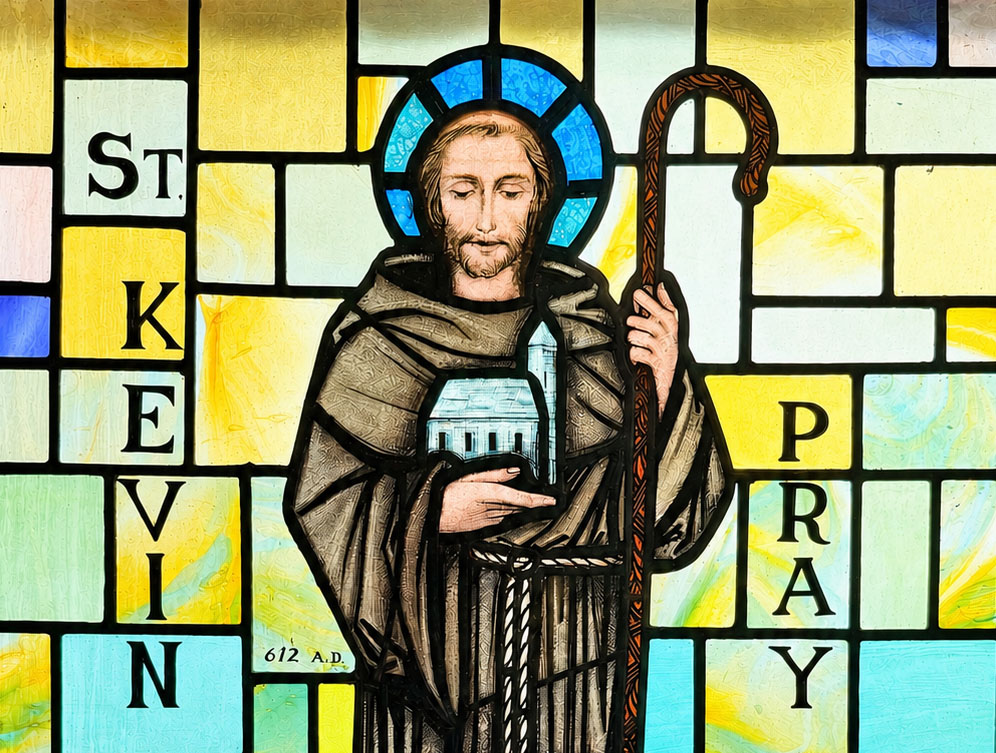
Feast of St. Kevin

Feast of St Kevin, June 3, 2026, St Mary’s Cathedral, Dublin

 Homily of Archbishop Dermot Farrell

Archbishop Dermot Farrell celebrated Mass in St Mary’s Cathedral, Dublin, on Wednesday, June 3, for the Feast of St Kevin. St Kevin of Glendalough is one of the principal patrons of the Archdiocese of Dublin. In the Archbishop’s homily, he called for the Church to recognise and encourage the gifts already present among the people of the Archdiocese for ministry, leadership and service. Using example of St Kevin, he called on people to discover the “hidden treasure” of a living relationship with God and to help others encounter that same faith.

(Also available at https://www.dublindiocese.ie/st-kevin-2026/)   

The Hidden Life of the Church

In every parish in our diocese, there are people of deep faith and profound commitment: people whose prayer is genuine and regular, for whom the sacraments, especially the Eucharist, are places of consolation and nourishment, and whose way of living is rooted in a genuine commitment to the way of living Christ puts before the world. These might not be the words they’d use to describe themselves, but they are the living Church in our parishes. They give of their gifts to parish pastoral councils, prayer groups, youth groups, sacramental preparation groups for the children, funeral ministry, finance committees; they reach out the poor and disadvantaged in their own communities and beyond. However, this life of the Church, and this is the real life of the Church, often remains somehow hidden, not only to the world, but also to the Church itself. It is a treasure that remains hidden to us. And it is on this hidden treasure that I’d like to reflect on with you on this Feast of St Kevin today.

The Sadducees and Jesus—Two Responses to What God is Doing in the World

In today’s Gospel (Mark 12:18–27), we have an encounter between Jesus and the Sadducees. The Sadducees find their way into the Gospels, not merely as witnesses to what Jesus was involved with, but because the values they embodied were also to be found in the early Church. Saint Mark is saying to the parishes that make up his community, “Do you remember that drama between Jesus and the Sadducees in the Temple? Well, what is going on among you is exactly the same thing!”

Like the Pharisees, the Sadducees were religious people. Their forebears had rebuilt the temple in Jerusalem, and they ran it in Jesus’ day. They were the custodians of the tradition, but the Sadducees understood their faith in a very worldly way. The horizon of their faith was what they could imagine, and they imagined things in a very mundane way. The evangelists tell us, again and again, that they had no belief in the resurrection (see Mark 12:18). In other words, what was real was what they saw. Today we might say, that they had no sense of mystery. They had little sense of the possibilities or horizons of God.

In the early Church, there were many people who shared that pragmatic horizon of the Sadducees, what one might call the values of the “establishment.” If God had acted, then God had acted along the way they deemed possible and would continue to act in the way they deemed important.  Their Christian ‘beliefs’ were founded on what was possible for them, not what was possible for God. Yes, they believed in Jesus, but they believed in Jesus in a very worldly way.

However, the victory of Jesus was not a victory in worldly way. The victory of Jesus was the victory of the cross. It was the victory of compassion; it was the victory of gentleness, not of brute force. It was the victory of turning the other cheek (see Matt 5:41), it was—and is—the victory of the “poor in spirit” (see Matt 5:3). It is the victory of forgiveness and patience, of littleness and simplicity, and it is costly.

Christ’s Way—Another Way of Being in the World

The victory of Christ is a victory that bears witness to another way of being in the world. The Sadducees are caught up in another victory—a victory in the past. Their forebears had returned from the exile in Babylon (597–538 BCE), rebuilt the Jerusalem temple, and in a real way, re-established the faith of their fathers, the faith of Abraham, and Isaac, and Jacob (see Gen 3:6, cf. Mark 12:26–27). That said, their horizon was in the past.

Today’s Gospel story is not really a theological argument about resurrection: it is far more an argument about what God can do. Jesus says the resurrection is beyond the Sadducees’ horizon, because they know neither the Scriptures nor the power of God. They do not know the Scriptures—the story of God with his people, and they do not know what God can do, they cannot imagine the possibilities of God.
Relics of St. Thérèse – 25th Anniversary

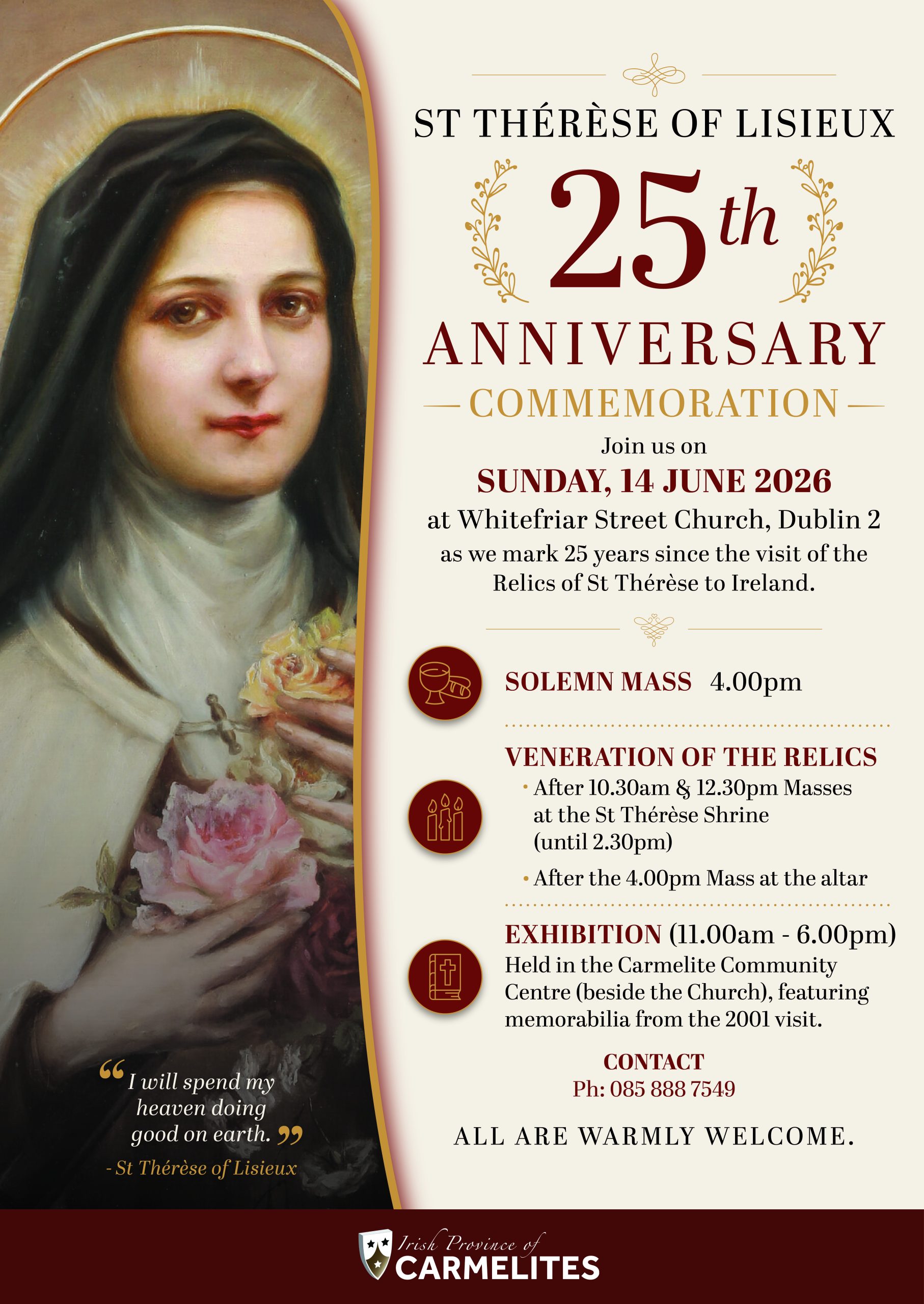
25th Anniversary of the Visit of the Relics of St. Therese to Ireland 2001

Fr.  Simon Nolan O.Carm, Prior Provincial of the Irish Province of Carmelites, and Fr. James Noonan OCD, Prior Provincial of the Anglo‑Irish Province of the Discalced Carmelites together with The St Thérèse Relics – The Sweeney Family will host a Commemoration Day to celebrate this anniversary in Whitefriar Street Church on the 14th June 2026.  
4pm – Solemn Mass to Celebrate the 25th Anniversary  
11.00am – 6pm – Exhibitions open to the public in the Whitefriar Street Carmelite Community Centre (Beside the Church)
Exhibition of memorabilia from the 2001 visit – video footage, photographs, newspaper articles, and much more & Exhibition on the life of St Thérèse and the Martin Family.
 
Veneration of the Relics of St Thérèse and her Parents St Louis & St Zelie Martin will be available after the 10.30am & 12.30pm Masses at the St Thérèse Shrine till 2.30pm Veneration after the 4pm Mass at the Altar 
 
May St Thérèse bring you and your families many blessings.
 

Marino Institute of Education

We have been running a Spirituality programme in Marino Institute of Education for more than 10 years. Thank you for your support and help over the years. Our formal participants found this course inspiring and enlightening. 

Are you looking for food for the mind and oxygen for the soul in the company of fellow seekers? Join the Adult Education Certificate in Spirituality and Human Development Programme. It is open for applications now. For more information, please see the following website www.mie.ie/spirituality. If you are interested, please contact Mary at mary.gao@mie.ie;   or 087 450 8549.    

Diocesan Courses

Pathways into Ministry and Certificate in Catechesis courses

 There will be an information evening in St. Paul’s (Arran Quay) on Monday 25th May at 7.30pm for anyone interested in completing either of these two courses, which are organised by the diocese.

Confirmation and First Holy Communion

Please remember in your prayers the children from our local schools, who will celebrate their Confirmation and First Holy Communion next week.

  • Scoil Chiarain – Confirmation – Tuesday 12th May at 12 noon.
  • Mother of Divine Grace School – Confirmation – Thursday 14th May at 12noon.
  • Sacred Heart School – First Holy Communion – Saturday 16th May at12 noon.

May Rosary on the Green

The Legion of Mary will have Rosary on the Green at 7.30pm on Wednesdays in May.

6th May – Church grounds at the statue.

13th May – Stormanstown Green.

20th May – Hillcrest Park.

27th May – Tolka Estate.

Novena to the Holy Spirit

You are warmly invited to join once again with every parish in the diocese in a Novena to the Holy Spirit – our dedicated period of prayer, reflection and planning for the renewal of the Church in the Archdiocese of Dublin.

The Novena will take place in the nine days from 17th – 25th May beginning on the Feast of the Ascension of the Lord, through Pentecost and continuing to the Feast of Mary, Mother of the Church.

Novena resources are being made available on the diocesan website

On Monday 11th May, in preparation for the Novena, you are invited to gather in the Monastery of St Alphonsus, Drumcondra, for prayer drawn from the Novena Prayer Booklet with music led by the Dublin Diocesan Music Group.

Event: Come Holy Spirit, Fill Our Hearts Anew!

Prayer and reflections drawn from the Novena Prayer Booklet

Music led by the Dublin Diocesan Music Group

Date: Monday 11th May 2026

Time: 8pm

Venue: Monastery of St Alphonsus, St Alphonsus’ Road Upper, Drumcondra, Dublin 9, D09 HN53

Webcam: www.rednuns.com/webcam

Diocesan Pilgrimage

Dublin Diocesan Pilgrimage to Knock

The Dublin Diocesan Pilgrimage to Knock took place on Saturday 25th April. This year’s theme: Baptised and Sent.
Workshops included – 1) Living your Baptism and your Mission in Life; 2) Baptism and Ministries; and 3) How
Confession Renews your Baptism.

Homily of Archbishop Dermot Farrell

In his homily during the 2026 Dublin Diocesan Pilgrimage to Knock, Archbishop Farrell pointed to the apparition at Knock, given to ordinary people and marked by silence, and how it invites the Church to reflect. Echoing words of the late Pope Francies, he said that although the Church appears to be in crisis, this shows it to be alive. Rather than decline, God is at work, calling the Church to rediscover its mission of bringing hope. The Archbishop called for the Church in the Archdiocese of Dublin to move forward in a synodal way, letting go of outdated structures and embracing renewal with courage.

Also available, with gallery of photographs by John McElroy, at https://www.dublindiocese.ie/knock-homily-2026/

Mary Byrne O’Connell, Patrick Byrne, Patrick Hill, John Curry, and Bridget Trench are not names we know. These people were five of the 15 visionaries here at Knock in 1879. To say the least, they were very ordinary, not well known, not unlike Bernadette Soubirous at Lourdes, or Jacinta, Francisco, and Lucía, the three children to whom Our Lady appeared in Fatima. They certainly were not wealthy or influential, if anything they were the opposite.

The apparition here at Knock is silent. Something happened and we have to make sense of it.

In Knock, we have an apparition to ordinary people—people like ourselves, and we have a silent apparition, a vision that we have to make sense of. In a very real sense, the apparition at Knock is a vision to the Church, to the people of God. The Church is the people God brings together in Christ. The Church is the people God gathered together in Christ, to whom God is close. This is the great gift of the Second Vatican Council, its great rediscovery: “God speaks to us as friends,” as the Council teaches (see Dei Verbum §2). Why do we celebrate the Mass in our own language today? Because our own language is the language of the people of God, the language of our own prayer, the language of our lives, the language of our pleas. Why do we celebrate this Mass around the altar? Because together we are the people of God, and our Lord is in our midst, and journeys with us, as together, we work out where our Lord is bringing us.

After the vision here at Knock had taken place, people and priests together had to work out what it was. It had to be determined whether it was an authentic vision. That was an important step. But, far more important, it had to be owned by the people of God. And Knock has been owned by the people. Today it is being owned by us: our presence here today is not only an expression of our faith, but it is also an expression of ownership. In our presence and prayer here today, the vision of Knock is bearing fruit; the Lord is at work among his people—the Lord is gathering his flock, leading us home (see John 10:3-4, 11; Isaiah 40:11; Ezekiel 34:11-16; Psalm 23:1-4).

It is not just in Knock or in places of pilgrimage that the Lord is gathering his people. The Lord is gathering his people everywhere; he is gathering them in Dublin. As we just heard in the Gospel of Mark, whose Feast we celebrate today, about the seed that grows in mystery, “the seed grows night and day, the sower knows not how” (see Mark 4:27).

A Church in Crisis—A Church that is Alive

The Kingdom of God is alive, and it is growing in ways we do not appreciate. As the parable says: “The kingdom of God is as if someone would scatter seed on the ground, and would sleep and rise night and day, and the seed would sprout and grow, he does not know.” (Mark 4:26–27)

You may say to me, “but the Church is falling down around our ears!” And the Church that we knew certainly is! You may say to me, “our churches are empty, very few are going to Mass,” and nobody will doubt that. You could point to 101 things to say that the Church in Ireland, and in Europe generally, is in crisis, and you would not be mistaken. But the Gospel itself asks us to see: God is at work among us. God is at work in all God’s creatures. The crisis is not a sign that the Church is in decline, but that the Church is alive. Pope Francis put it wonderfully: “the Church always has difficulties,” he said. The Church “is always in crisis, because she’s alive,” he pointed out, “living things go through crises. Only the dead don’t have crises.” (Video Message of the Pope’s Worldwide Prayer Network, August 3, 2021).

Our Church is alive! We are in crisis, but we are alive! “Only the dead don’t have crises.” In his wisdom and in the light of faith, Pope Francis could see clearly that it was in the nature of a crisis to reveal what was in people’s hearts. (see Austen Ivereigh, “A Time to Choose”, The Tablet, April 25, 2026, p4)

The crisis which we are living has many causes, but its call is clear. It is a call to re-discover our calling and our mission as the Body of Christ. Pope Leo put it like this a few days ago, “Mindful that the aim of mission is not [Church’s] own survival” but “the Church… [That is all of us, together are] called to live with confident courage, as a small flock bringing hope to all” (Letter of Pope Leo to the Cardinals, April 2026).

How that is to be done is something we have to work out together—“the small flock bringing hope to all”? Smallness is not the issue. Remember the mustard seed in today’s Gospel! Working together is the challenge. Weakness is not the issue. Remember that the power-conscious St Paul learned (and learned painfully) that the “weakness of God was stronger than human strength” (see 1 Cor 1:25). Weakness is not the issue: being a living member of the Body of Christ (see 1 Cor 12:27) is the issue. Every single person is a vital part of the Body of Christ. Every one of us has something to give, something that only we can give.

The Church is the Body of Christ, and Christ is alive among us and within us. He is calling us to be with each other in him. It is ordinary people he calls. I say again: the crisis in the Church is not a crisis of vocations, but a crisis of vocation! Together, we must work out how to live out our calling to follow Christ—our baptismal calling—in the Dublin of today. Together, we have to work out how, we share our suffering, how—together—we can carry our crosses (see Mark 8:34–25), but also how together we can discover and share “the joy of the Gospel”.

The visionaries at Knock had to work out what they had seen. In that, they were living out their vocation. They were being synodal, ever before the term was in use! Let us not confuse the label with the reality. The visionaries at Knock had to work out what they had seen. Together, with the priests and their bishop, those in the ministry of leadership, they had to work things out.


In our Church today, we have to let certain things go. There is loss in this, but also a liberation: letting go frees us up. The Holy Spirit is at work among us. This is what we mean by “synodality”. To use another image from St Mark, we are attached to old wine skins (2:22) which are no longer fit for purpose. The “new thing” (see Isa 43:18-19; Rev 21:5) God is creating cannot fit into old structures. Journeying together into the future, and this is the meaning of synodality, means making decisions together and not doing things or making decisions in isolation. All this involves a change in the style of how we are the Church, how our parishes and communities work. There are things we have to do, if we are effectively to proclaim “the Good News of God” (see Mark 1:14). We will have to recognise more profoundly our charisms, our gifts. And, as a recent Report on the Synod clearly underlines, we will certainly have to actively enable the participation of women in our one mission (see General Secretariat of the Synod, Final Report of Study Group No. 5 on Women’s Participation in the Life and Leadership of the Church).

What is at stake? At stake is the reality of our Christian vocation, and the credibility of our mission. Last Sunday, in Angola, Pope Leo named it forcefully,

“Today we need to look to the future with hope and to build the hope of the future. Do not be afraid to do so.” (Homily, Kilamba, Angola, April 19, 2026)

“Do not be afraid!” The first words of Jesus to those to whom he is close.

Our Lady of Knock, pray for us.
Saint Mark, pray for us.
Saint John XXIII, Saint Paul VI, Saint John Paul II, pray for us.

 +Dermot Farrell
Archbishop of Dublin

Lay Ministry Sunday May 2nd/3rd

The Lay Ministry Appeal will take place on the weekend of May 2/3 and will replace the Share collection. Further information here

Extract from Archbishop Farrell’s letter

“We are called to be builders of faith so that we can confidently share our faith in Christ with others.

Thanks to your contributions on Lay Ministry Sunday, the diocese can now offer subsidies to participants of the Diocesan Certificate in Catechesis, the Pathways into Ministry Programme and the Youth Ministry Leadership Certificate.

This year, 1,500 people are participating in formation for voluntary ministries – a great sign of hope to us all. In addition,
through the work of the Office of Mission & Ministry, parish ministries such as Lay Funeral Prayer Leaders continue to be
supported, formed and resourced.

Please help to support lay ministry initiatives. Your committed generosity, today and every day, makes a difference.

Together we can build parishes and partnerships that are alive and active, joyful and faith-filled, synodal and missionary